Top / Urban Legends & Mysteries

10 — Odd Tales

A place strong enough
to spawn its own rumors.

A land carrying this much myth and history naturally accumulates its share of "urban legends," passed around online and by word of mouth — rumors of coins thrown at the shimenawa rope, theories of a hidden seal at the heart of the great hall, strange personal accounts from a "power spot." Here we set these odd tales deliberately alongside Izumo Taisha's official positions and the documented facts. As on every other page of this site, read on keeping legend as legend, and fact as fact.

One of Japan's largest shimenawa ropes hanging at the Kagura Hall, with worshippers walking beneath it
The great shimenawa rope of the Kagura Hall — setting for no shortage of rumors

Common Rumor No. 1

"If your coin sticks in the shimenawa, it's good luck"?

It was once a common sight: tourists looking up at one of Japan's largest shimenawa ropes, hanging from the Kagura Hall of Izumo Taisha, and tossing coins at it. This was fueled by a rumor, spread partly through television programs, that "if a coin sticks in the shimenawa, it brings good luck." Believing that a coin wedged successfully into the straw would make a wish come true, visitors kept throwing spare change at the rope rather than placing it quietly in the offering box.

Izumo Taisha's official answer: On its official website's FAQ, Izumo Taisha directly rejects this practice, stating that it is "disrespectful to the gods" and "therefore not something that brings good luck." A shimenawa is, first and foremost, a sacred boundary marking off holy ground from the ordinary world, and throwing objects at it is fundamentally at odds with proper worship. Today, measures such as wire netting have been installed beneath the rope to prevent this. The proper etiquette when visiting is to place your offering quietly into the offering box.
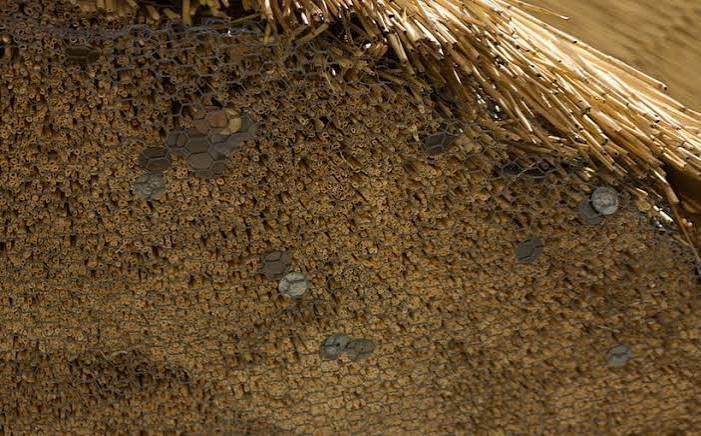
Numerous coins lodged in the gaps of the straw shimenawa rope
Coins lodged in the shimenawa (measures are now in place)

Common Rumor No. 2

"The shimenawa is twisted the opposite way from Ise Jingu"?

Another common piece of trivia — or urban legend — claims that "Izumo Taisha's shimenawa is twisted in the opposite direction from Ise Jingu and most other shrines." The idea is that while an ordinary shrine's shimenawa is typically thicker on the right as you face it — a "right-hand twist" — Izumo Taisha's great shimenawa is thicker on the left, a "left-hand twist."

Not unique to Izumo Taisha alone: This left-right difference can indeed be seen and confirmed in person, but it is generally understood not as something exclusive to Izumo Taisha, but as a feature often seen at shrines built in the "taisha-zukuri" style shared by Izumo Taisha's great hall. It's worth keeping in mind that framing it as "a reversal unique to Izumo Taisha alone" may involve some exaggeration.

A Theory Told on Occult-Themed Websites

"Izumo Taisha is a barrier sealing away Okuninushi's vengeful spirit"?

Some occult-themed websites tell a rather bold "urban legend" about Izumo Taisha. The theory holds that Okuninushi, having had his land taken from him in the Kuniyuzuri, is actually "one of Japan's most powerful vengeful spirits," and that the colossal hall of Izumo Taisha was built as a "barrier" to pacify and seal that spirit away.

This theory draws a comparison to "goryo shinko," the belief that the spirits of those who died unjustly or fell from grace in bitterness could be pacified by enshrining them reverently as gods — the Tenmangu shrines dedicated to Sugawara no Michizane are a well-known example — and argues, by the same logic, that Okuninushi, defeated in the Kuniyuzuri, may likewise have been an object of worship meant to avert a curse through careful enshrinement. This theory sometimes extends its own interpretation even to the fact, introduced on the "Mystery of the Great Hall's Height" page, that the sacred object sits facing west rather than south toward the main approach — claiming that "because a vengeful spirit can only move in a straight line, the structure was deliberately offset from the main approach as part of the barrier."

Enjoying this as an urban legend: Goryo shinko itself is a real form of belief that genuinely exists in the history of Japanese religion. However, applying it directly to the Kuniyuzuri myth and the founding and structure of Izumo Taisha, as this "sealed vengeful spirit" theory does, is best understood not as an academically established historical consensus, but as a kind of urban legend that has spread online. As noted on the "Mystery of the Great Hall's Height" page, Izumo Taisha itself has offered no official explanation for why it faces west. It's best enjoyed as one "story" about how to interpret the myth, kept separate from documented history.

Power-Spot Testimonials

"Visit during Kamiarizuki, and your body feels different"?

Izumo Taisha is often described as one of Japan's foremost "power spots," and travel blogs and social media are full of personal accounts — especially from visits during Kamiarizuki — describing sensations like "my body felt lighter" or "a strange feeling of floating." The reasoning goes that because this is the period when the eight million gods of the nation are said to gather, the energy of the grounds feels different from usual.

These accounts rest entirely on personal, subjective impressions and are not scientifically verified phenomena. Still, a place that has drawn people's faith for over 1,300 years carries the weight of that much story and history. Visiting in person and taking in the atmosphere with your own eyes and feet is one of the pleasures of traveling to Izumo, whatever you make of it.

Read Next

Rumor or myth, the best way to check it is to walk there yourself.

Whatever the truth behind these urban legends, Izumo Taisha and its surroundings are places well worth visiting in person. To close out this site, here's a roundup of sightseeing spots for walking Izumo City.

Read About Sightseeing Spots →