The Heart of the Tradition
"In the tenth month, the gods of the whole nation gather in Izumo, leaving every other region without them" — this is the widely known tradition behind Kannazuki and Kamiarizuki. Regions outside Izumo call this month "Kannazuki," while Izumo, which welcomes the gods, calls it "Kamiarizuki."
That said, this is best understood as a folk etymology that spread from the medieval period onward. Linguistically, the more widely accepted view is that the "na" in "Kannazuki" is actually an old possessive particle meaning "of," so that the name originally meant simply "the month of the gods." The story that the gods are away in Izumo, leaving their home month "godless," is likely not the true origin of the word, but rather an explanation that took hold later — one shaped by the sheer presence of the rites actually performed in Izumo at this time of year.
Welcoming the Gods on the Shore
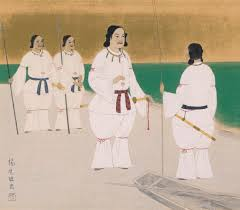
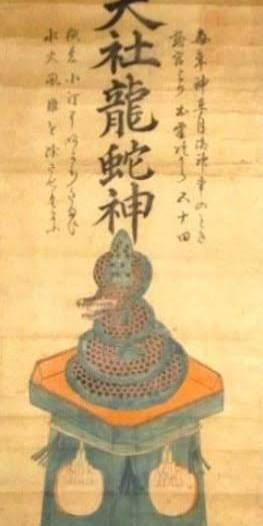
On the night of the tenth day of the tenth lunar month, priests and parishioners of Izumo Taisha gather at Inasa Beach and light bonfires to await the gods' arrival. In this rite, known as "Kamimukae Shinji," the god-welcoming rite, tradition holds that "Ryuja-sama" — a sea snake believed to cross the ocean and regarded as a messenger of the Dragon-Serpent God — leads the gods ashore as their guide.
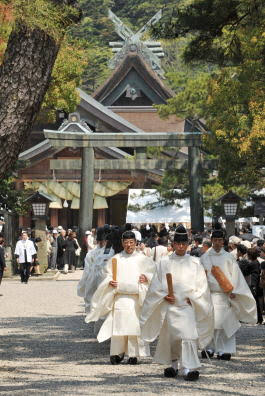
The welcomed gods, accompanied by the sacred fire, are then said to travel along the "Path of the God-Welcoming" from Inasa Beach into the grounds of Izumo Taisha. Once inside, the gods are said to lodge in the long hall known as the "Jukusha," the Nineteen Shrines, located to either side of the worship hall, and its doors are specially opened for the occasion.
What Do the Gods Come to Do?
On a small rise behind the great hall, within the grounds of Izumo Taisha, stands a small shrine called the "Kaminomiya," the Upper Shrine. During Kamiarizuki, the gods gathered from across the nation are said to convene here for a council known as "Kamihakari." The subject of this council is said to be the forging of people's "en" — bonds — not only romantic ones between men and women, but the countless ways people meet people, and people meet circumstance. This is one reason Izumo has long been revered as "the land of matchmaking."
Izumo Taisha is not the only place where the gods are said to gather during Kamiarizuki. Sada Shrine, located in Kashima-cho, Matsue City, south of Izumo City, also holds its own Kamiari Festival, suggesting that belief in Kamiarizuki runs deep throughout the wider Izumo region.
A Week of Tradition
The gods are welcomed at Inasa Beach, then proceed with the sacred fire along the Path of the God-Welcoming to Izumo Taisha.
The period during which the gods are said to hold their council on the shrine grounds. Locally, a custom of quiet restraint known as "Oimi-san" is observed nearby.
A rite is held marking the gods' departure from Izumo Taisha for other shrines.
At Makuse Shrine in Hikawa-cho, Izumo City, a rite is held marking the gods' final departure from Izumo.
Read Next
Izumo Taisha is said to be where the gods of the entire nation once gathered as one. According to Heian-period records, its great hall was the tallest building in Japan at the time. The next page traces the little-known ancient reality behind this hall, where myth and faith still live on.
Read the Mystery of the Great Hall's Height →