Directly Behind the Great Hall
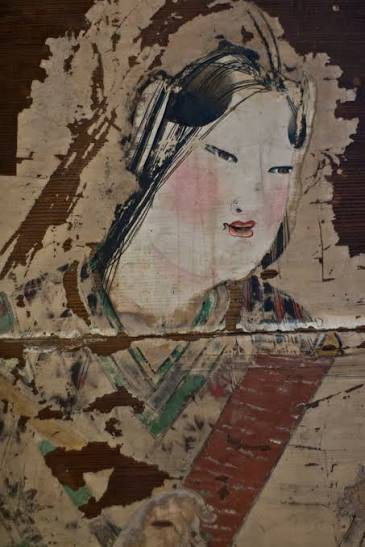
Directly behind the great hall of Izumo Taisha, at the foot of Mt. Yakumo, stands a small shrine called "Sogasha." Its enshrined deity is Susanoo, father of Okuninushi. Its position right behind the great hall alone suggests how carefully this shrine has been treated as something special.
Sogasha carries a distinctive practice of its own. Visitors first purify and bring back sand from Inasa Beach, then exchange it for "osuna" — sacred sand — kept beneath the floor of Sogasha. This sand, once received, is said to purify and protect a home when scattered around its grounds — linking Inasa Beach, Sogasha, and the great hall of Izumo Taisha into a single circuit of faith in which the worshipper themselves plays a part in the "musubi," the bond.
A Grove Near the Grounds
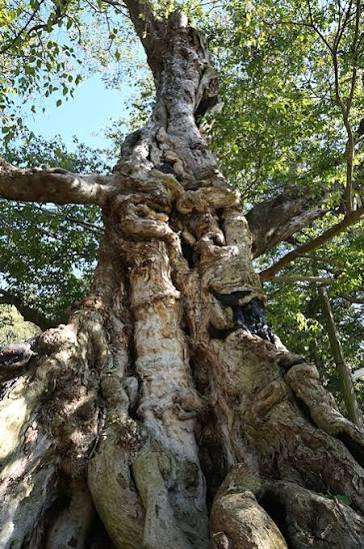
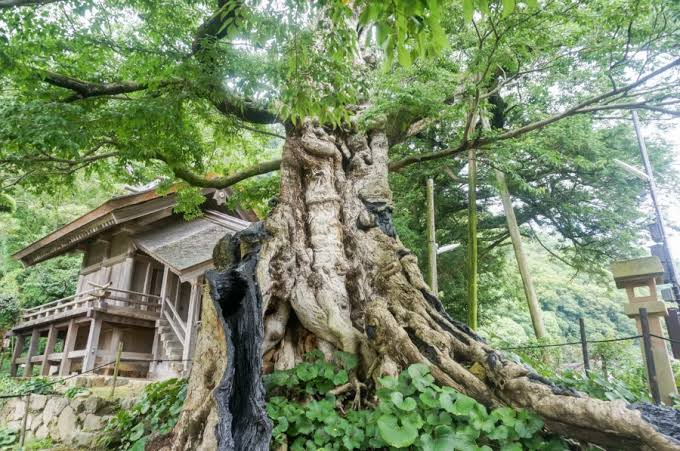
East of Izumo Taisha, near the Mani-i spring, stands an old shrine called "Inochinushi-sha." Its enshrined deity is Kamimusuhi-no-kami, one of the three creator deities who appear at the very opening of the Kojiki, at the dawn of heaven and earth. Behind the shrine towers a great Japanese zelkova tree, said to be some 1,000 years old, giving the site a distinctive presence.
In 1665, during construction work on the shrine building, a large curved bead (magatama) made of jadeite and a bronze halberd (doka) were discovered nearby. Believed to date back to the Yayoi period, these artifacts are valuable evidence that the area around Inochinushi-sha has served as a site of ritual practice since ancient times.
Setting of the Myths
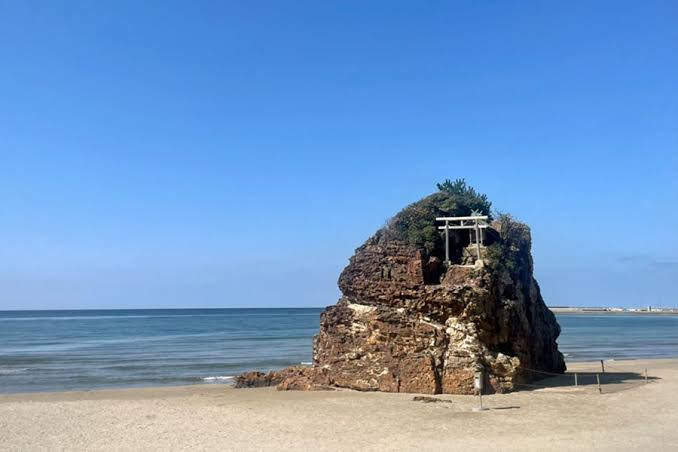
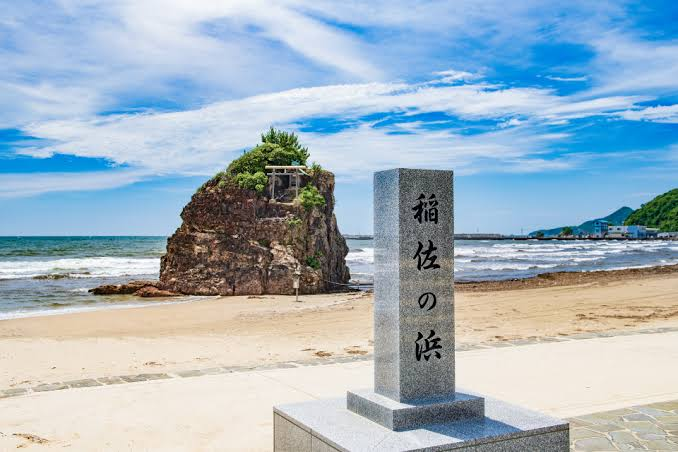
About a kilometer west of Izumo Taisha lies Inasa Beach, already mentioned several times on this site as one of Izumo's foremost sacred sites. As seen on the "Okuninushi and the Kuniyuzuri Myth" page, this is the beach where Takemikazuchi is said to have descended to demand the ceding of the land, and it's also where the Kamimukae god-welcoming rite covered on the "Kamiarizuki" page begins.
On the beach stands a small rocky islet called "Bentenjima," topped with a small shrine dedicated to Toyotama- hiko. At dusk, the sun can be seen setting into the Sea of Japan beyond Bentenjima, making this a favorite spot among photographers.
A Sacred Site Out to Sea
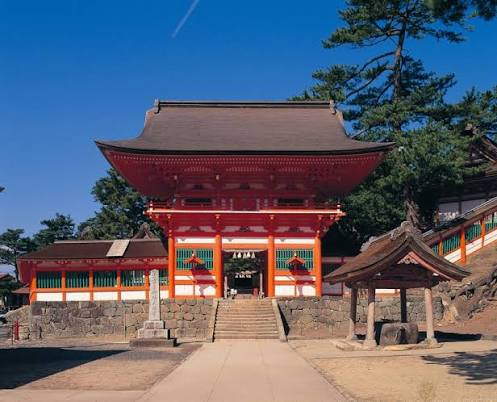
Northwest along the coast from Izumo Taisha, at Hinomisaki, stands Hinomisaki Shrine. This shrine, known for its beautiful vermilion halls, consists of an upper and lower shrine: the upper hall, "Kami-no-Miya," enshrines Susanoo, while the lower hall, "Hishizumi-no-Miya" — the Shrine of the Setting Sun — enshrines Amaterasu. That the hall dedicated to Amaterasu, the sun goddess, is named "the Shrine of the Setting Sun" reflects a form of local faith distinctive to this region, one that links the sun goddess to the sun setting into the western sea.
Offshore from Hinomisaki Shrine floats a small uninhabited island called "Fumishima." Known as a major breeding ground for black-tailed gulls, the island is designated a natural monument of Japan. Each year around November, large numbers of gulls arrive, and by early summer the island turns nearly white with their numbers amid a chorus of calls. Landing on the island is normally forbidden, as it is sacred ground, but the scene can be viewed from the heights of Hinomisaki or from a sightseeing boat.
Read Next
The legend behind "zenzai," said to originate with Kamiarizuki, warikko soba, Izumo's signature style of buckwheat noodles, and the shijimi clams of Lake Shinji. Let's trace the food culture rooted in this land of faith.
Read About Izumo's Food & Matchmaking →