Testimony from the Heian Aristocracy
The Kuchizusami, thought to date from around the year 970, was essentially a Heian-period primer gathering the knowledge aristocratic children were expected to know. It contains a famous passage ranking the great buildings of the day by size: "Untai, Wani, Kyosan" — meaning the largest was Izumo (Taisha), the second was Yamato (the Great Buddha Hall of Todai-ji), and the third was Kyo (the Daigokuden of the Heian palace).
Todai-ji's Great Buddha Hall is known today as one of the largest wooden structures on earth still standing. That Heian aristocrats casually recorded a building in Izumo as surpassing even that hall speaks to just how astonishing the great hall of Izumo Taisha must have been in its day.
2000: From Beneath the Ground
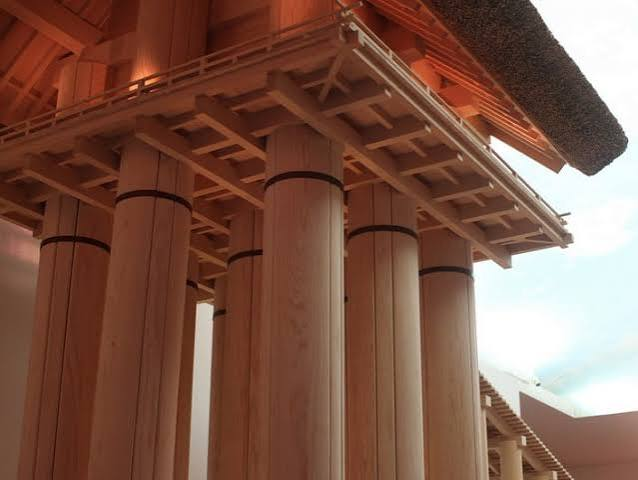
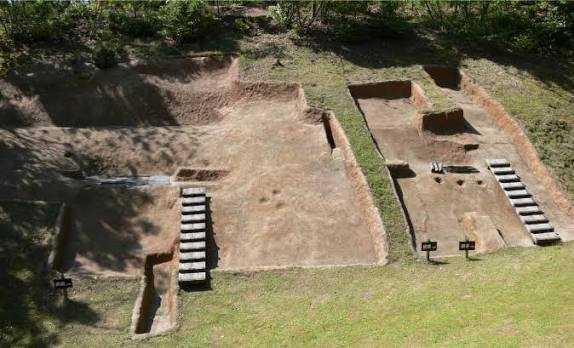
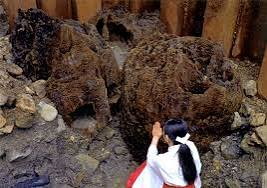
Excavations of the shrine grounds carried out from 2000 to 2001 turned up a discovery that would go down in archaeological history. At three locations on the grounds, the bases of pillars roughly 3 meters in diameter were found — each one bundling three great cedar trunks bound together with iron rings. Each individual cedar trunk in the bundle measured about 1.4 meters across.
Of these, the pillar unearthed at the position directly in front of the great hall is known as the "Uzu-bashira" and is thought to be part of a pillar that once actually supported the great hall built in the early Kamakura period (early 13th century). This was solid physical evidence that a hall built with colossal triple-bundled pillars had existed at least by the medieval period — not merely a legendary building, but a real one.
A Diagram, Handed Down All Along
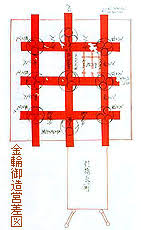
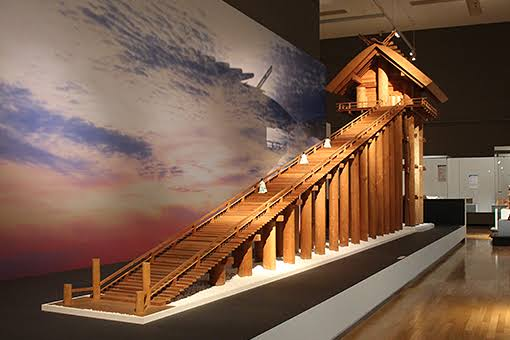
Intriguingly, the Izumo Kokuso family had long preserved a diagram known as the "Kanawa Zoeizu," a sketch plan depicting the form of the great hall. It shows nine pillars, each made of three trunks bound with metal rings, and a long, stepped approach ramp called the "Hikihashi" leading up from the ground to the hall.
Before the 2000 excavation, this diagram was often treated as a later, imaginative rendering — essentially a picture drawn to illustrate legend. But once traces of the actual triple-bundled pillars were unearthed from the ground, it became far more plausible that the diagram was, at least in part, a valuable historical document genuinely conveying the structure of a hall that once really stood.
A Mystery That Remains
The discovery of the Uzu-bashira lent strong support to the possibility that a colossal hall once stood at ancient Izumo Taisha, but it does not by itself confirm that "the great hall stood 16 jo, roughly 48 meters, tall." Efforts to reconstruct the hall's structure from the position and scale of the excavated pillars continue today, and researchers still debate the height — the 48-meter theory alongside others proposing a more modest scale.
One More Mystery
Height is not the only mystery surrounding the great hall of Izumo Taisha. Worshippers at the worship hall bow facing south toward the great hall, but the sacred object within — Okuninushi himself — is said to actually sit facing west inside the hall. Because of this, worshipping from directly in front of the hall (its west side) is said to bring one more directly face to face with Okuninushi, and a small worship spot has in fact been set up on the west side for this purpose.
Several explanations circulate for why he faces west — one holds that he faces toward Inasa Beach, the sea associated with him; another connects it to the direction of the setting sun and the Western Pure Land. Neither of these, however, is an established, confirmed explanation.
Read Next
Izumo, where a colossal shrine hall is said to have once towered. According to the myth that opens the Izumo no Kuni Fudoki, the land of Izumo itself was pulled in from across the sea with a great rope. Let's move on to the Kunibiki myth — a story every bit as grand in scale as the mystery of the great hall.
Read the Kunibiki Myth →