The 1983 Discovery
The Kojindani site, in Hikawa-cho, Izumo City, was discovered in 1983 during a distribution survey ahead of regional road construction, when a fragment of Kofun-period sue ware pottery turned up along a rice-paddy footpath. The site takes its name from a small shrine to Sanbo-Kojin standing to its south.
When full-scale excavation began the following year, in 1984, the tip of one bronze sword appeared, then another. As the dig continued, it became clear this was an enormous quantity of bronze swords, laid out neatly in four rows. In the end, 358 swords were recovered. At the time, the total number of bronze swords previously found across all of Japan was estimated at roughly 300 — meaning this single site nearly doubled the nation's entire prior record.
More Than Just Swords
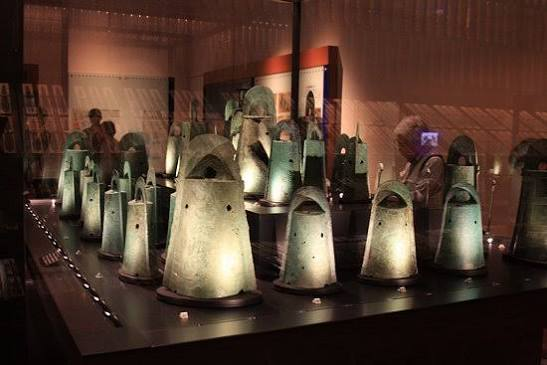
The excavation continued further. In 1985, at a spot not far from where the 358 swords had been found, a cache of 6 bronze bells (dotaku) and 16 bronze spearheads (doboko) was discovered together. A single site holding three distinct categories of bronzeware — swords, bells, and spearheads — buried in such proximity to one another was, at the time, an almost unknown combination.
Many of the swords bear an "X" mark carved into them — confirmed on more than 344 of the 358 swords. Debate continues over what this mark means: some argue it identified the maker or owner, others that it carried a ritual significance. These bronze objects are thought to have been buried not as functional weapons, but as treasures used in ritual practice.
Another Discovery, Just a Few Kilometers Away
In Kamo-cho, Unnan City, about 3.3 km from Kojindani, another huge cache of bronzeware was found in 1996, again during road construction — the Kamo-iwakura site. Thirty-nine bronze bells were unearthed here, again setting the national record for the largest number of bronze bells ever found at a single site.
Even more striking, some of the bells found at Kojindani and some of those found at Kamo-iwakura were confirmed to have been cast from the very same mold. This was crucial evidence of a direct link between the two caches of bronzeware, buried at sites barely a few kilometers apart as the crow flies.
An Echo of the Myths
Before the discoveries at Kojindani and Kamo-iwakura, Yayoi-period Izumo was not considered a particularly notable center of bronze culture compared with Yamato (the Kinai region) or northern Kyushu. But the sheer fact that a power capable of holding and burying such a vast quantity of bronze ritual objects existed in Yayoi-era Izumo offered archaeological, physical evidence that ancient Izumo may have built an independent sphere of power and culture of its own.
Researchers and local historians alike often read the Kuniyuzuri myth recorded in the Kojiki — in which the god of Izumo cedes his own land to the god of Yamato — alongside these archaeological finds, suggesting it may reflect a historical memory of an independent power in ancient Izumo that once rivaled the Yamato court.
Read Next
The memory of ritual practice in ancient Izumo, stretching back to the Yayoi period, connects directly to the Izumo Kokuso family, who carry out the rites of Izumo Taisha today. Let's trace this priestly family's 1,300-year history, and how its lineage came to split in two.
Read About the Izumo Kokuso Family & Shrine Renewal →