Where the Story Begins
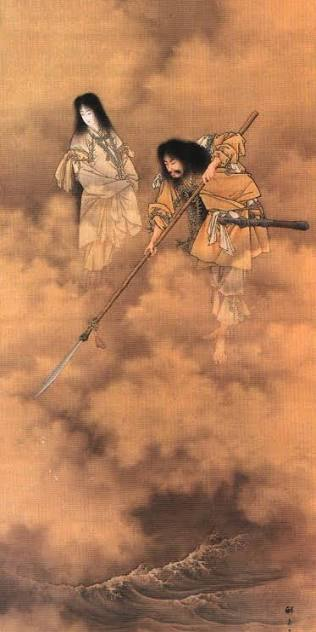
Susanoo is one of the "Three Noble Children" born when Izanagi purified himself after returning from Yomi, the land of the dead. His elder sister is the sun goddess Amaterasu, and his elder brother is Tsukuyomi, god of the moon. Izanagi charged Susanoo with ruling the sea, but Susanoo, grieving endlessly for his dead mother Izanami, abandoned his duties and simply wept.
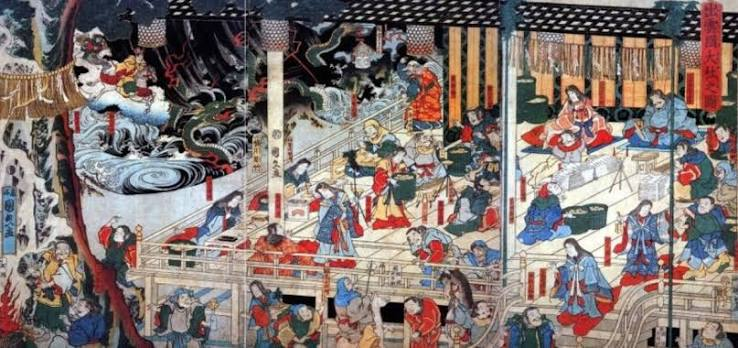
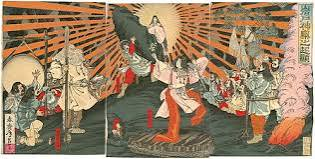
Enraged, Izanagi banished him, and Susanoo climbed to Takamagahara to bid farewell to his sister Amaterasu. After that visit, though, he went on a rampage — destroying rice-paddy ridges, flaying a heavenly horse and hurling its hide into the weaving hall, and more. His conduct is said to have been one cause of the famous episode in which the grieving Amaterasu shut herself away in the Ama-no-Iwato, the heavenly rock cave — one of the best-known incidents in all of Japanese mythology. Held responsible, Susanoo was expelled from Takamagahara by the other gods and cast down to the earthly realm.
Descent into Izumo
Exiled, Susanoo descended at a place called Torikami, the upper reaches of the Hii River, in what is now Okuizumo Town, Shimane Prefecture. There he came upon an elderly couple weeping in grief, along with their daughter. The couple were Ashinazuchi and Tenazuchi, and the daughter's name, it is said, was Kushinada-hime.
Hearing their story, Susanoo learned that the couple had originally had eight daughters, but every year a monster called Yamata-no-Orochi appeared and devoured one of them. Now, this year, it was the turn of their eighth and last remaining daughter, Kushinada-hime, to be eaten. Susanoo offered to slay the serpent himself, on the condition that he take Kushinada-hime as his wife.
A Battle Won by Cunning
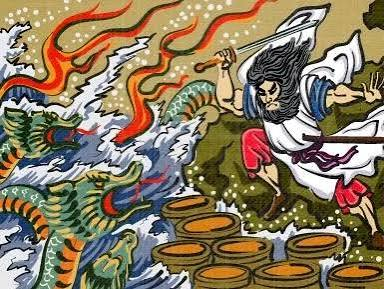
Susanoo's approach to Yamata-no-Orochi was not a straightforward duel of strength. First, he had a potent sake brewed through repeated fermentation, called "yashiori-no-sake" — eightfold-brewed sake. He had a fence built with eight gateways, and at each one set a vat brimming with the sake.
When the eight-headed Yamata-no-Orochi appeared, it plunged each of its heads into a vat, drank the strong sake dry, and fell into a drunken sleep. Seizing the moment, Susanoo drew the sword at his waist, the Totsuka-no- Tsurugi, and cut the serpent to pieces, slaying it at last.
A Sacred Sword from the Tail
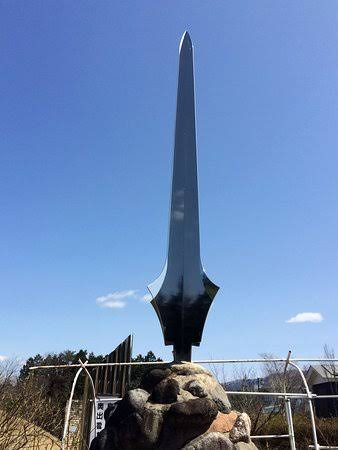
As Susanoo cut the serpent apart, he noticed that his blade chipped when it struck one of the tails. Curious, he split the tail open and found within it a splendid sword. This was the Ame-no-Murakumo-no-Tsurugi. Susanoo is said to have presented this sword to Amaterasu in Takamagahara.
The Ame-no-Murakumo-no-Tsurugi later came to be counted among the "Three Sacred Treasures" symbolizing the imperial throne. Still later, it came to be known as the "Kusanagi-no-Tsurugi" — the Grass-Cutting Sword — after an episode in which Yamato Takeru used it to cut down grass and escape a deadly trap during his eastern campaign. Today it is said to be enshrined as the sacred object of Atsuta Shrine in Nagoya. That a single battle in Izumo would ultimately connect to a treasure of the imperial house is a striking illustration of the sheer scale of Japanese mythology.
Said to Be Japan's Oldest Waka
Having slain the serpent and taken Kushinada-hime as his wife, Susanoo traveled through Izumo in search of a fitting place to settle, and arrived at Suga (thought to be near present-day Daito-cho, Izumo City). There, he is said to have declared, "Coming to this place, my heart feels refreshed," and built his palace. The poem he is said to have composed at that moment is this one:
Yakumo tatsu / Izumo yaegaki / tsumagomi ni / yaegaki tsukuru / sono yaegaki wo Kojiki — the poem Susanoo is said to have composed at the Palace of Suga
The poem — meaning roughly "Eightfold clouds rise; I build an eightfold fence, like an eightfold fence of clouds, to enclose my wife within" — is recorded in the Kojiki as the earliest waka poem on record, and is regarded in the history of Japanese literature as the "oldest waka in Japan." The phrase "yakumo tatsu" — "eightfold clouds rise" — which became a poetic epithet for the name "Izumo," is said to have spread from this very poem.
The Place of His Final Rest
In Sada-cho, Izumo City, stands Susa Shrine, dedicated to Susanoo. According to the Izumo no Kuni Fudoki, Susanoo took a great liking to this land and declared, "This is a small land, but a good land. I shall give it my own name, rather than a name of rock or wood" — and so named it "Susa." This tradition has led Susa Shrine to be passed down through the generations as the "place of Susanoo's final rest," the shrine where his spirit is said to be enshrined at peace.
Behind the main hall towers a great tree known as "Osugi-san," said to be some 1,300 years old, testifying to the depth of the sacred precinct. The shrine's current priestly family is said to descend from Ashinazuchi, the deity associated with Susanoo, and to have carried on as the Susa Kokuso for 78 generations.
Read Next
Okuninushi, who carries Susanoo's bloodline down from the Palace of Suga, is said to be visited every tenth lunar month by the gods of the entire nation. From mythic lineage to a living practice of faith that continues today — let's move on to the Kamiarizuki page.
Read About Kamiarizuki →